
VO₂ Max and Longevity: Why Fitness Predicts How Long You'll Live
VO₂ max is one of the strongest predictors of lifespan. Here's what it measures, what the data shows, and how to improve it at any fitness level.

Manifold Health Clinical Team
Medically reviewed clinical content
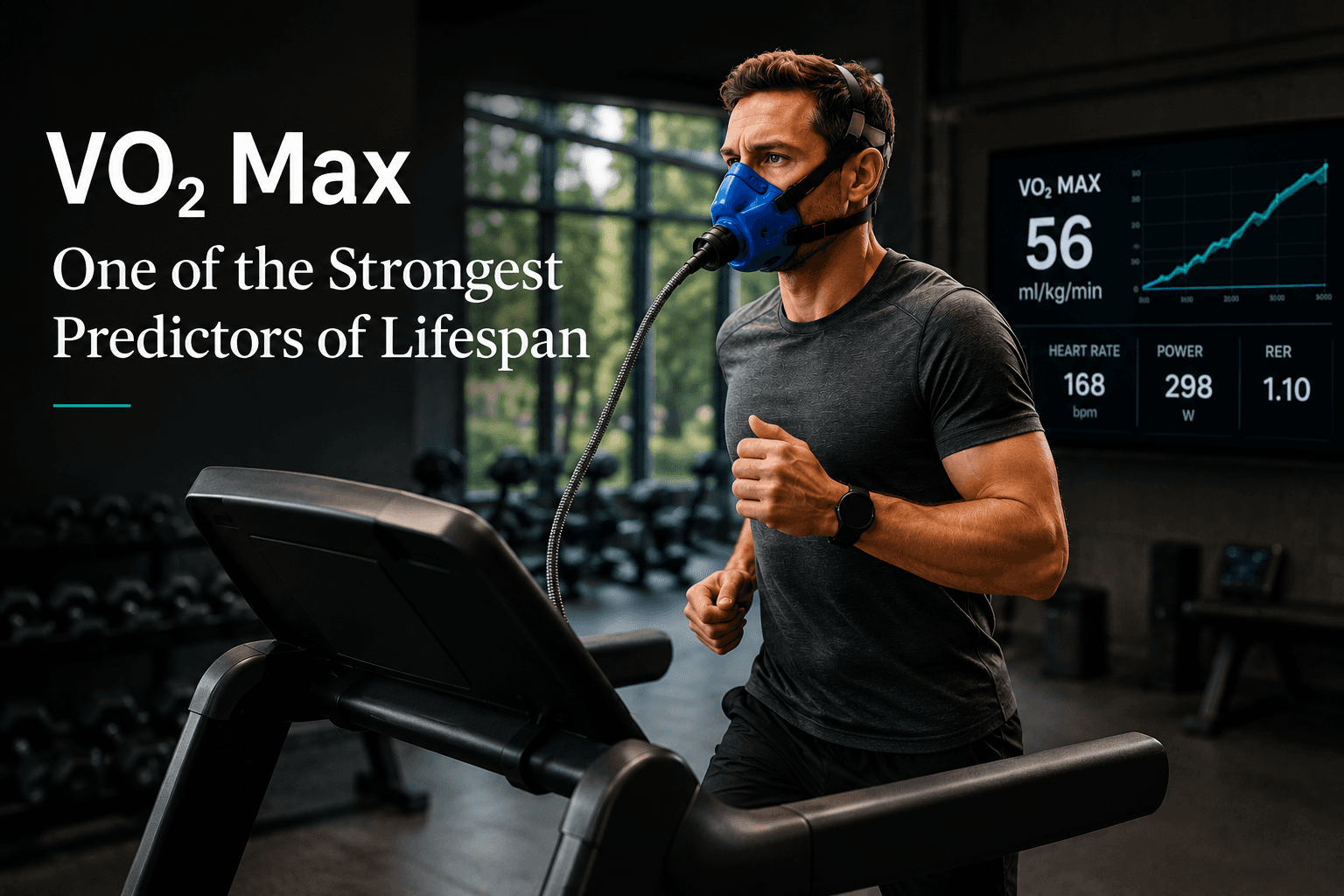
Table of contents
Share
If you could track just one number to predict how long you'll live, the evidence makes a strong case for VO₂ max — a measure of fitness that outperforms many traditional risk factors.
VO₂ max is the maximum amount of oxygen your body can use during intense exercise. It reflects how well your heart, lungs, blood, and muscles work together — and it turns out to be one of the most powerful predictors of longevity we have. This guide explains the science and how to move your number in the right direction.
This is educational content, not medical advice. Check with a clinician before starting a new exercise program, especially if you have heart disease or risk factors.
The short version
VO₂ max measures your body's maximum oxygen uptake — a proxy for cardiorespiratory fitness.
Higher fitness is consistently linked to lower all-cause mortality, and the effect is large.
The biggest gains come from going from low fit to moderately fit — you don't need to be an athlete.
What the data actually shows
The relationship between fitness and survival is one of the most robust in all of preventive medicine. A large analysis of over 750,000 U.S. veterans found that each one-MET increase in fitness (about 3.5 ml/kg/min of VO₂ max) was associated with roughly a 13–15% lower risk of death — independent of age, BMI, sex, and other conditions. A 2024 meta-analysis spanning more than 20 million observations reached the same conclusion: cardiorespiratory fitness is a strong, consistent predictor of mortality and disease.
Strikingly, the data suggest that being fit can offset some of the risk associated with higher body weight — fitness, not just thinness, is what tracks with survival.
Why VO₂ max matters so much
VO₂ max integrates the health of multiple systems at once: cardiac output, lung function, blood oxygen-carrying capacity, and mitochondrial efficiency in muscle. A high number signals that your whole physiology is working well. It also reflects your functional reserve — the capacity that keeps you independent and resilient as you age, which is central to healthspan, not just lifespan.
What's a good VO₂ max?
VO₂ max is measured in milliliters of oxygen per kilogram of body weight per minute (ml/kg/min) and naturally declines with age. Values are interpreted relative to your age and sex — moving up even one fitness category (e.g., from "low" to "below average") carries meaningful risk reduction. The practical takeaway: your trend over time matters more than hitting a single magic number.
How to improve your VO₂ max
The good news: VO₂ max is highly trainable. The most effective approach combines a large base of easy aerobic work with a smaller dose of hard intervals — often called polarized training.
Build the base: most of your weekly activity should be easy, conversational-pace cardio (zone 2).
Add intervals: 1–3 sessions per week of higher-intensity efforts (e.g., 4-minute hard intervals with recovery) drive the biggest VO₂ gains.
Be consistent: studies show measurable improvements — sometimes ~10% in weeks — with structured training.
Start where you are: if you're sedentary, even brisk walking can improve your fitness.
Strength training and adequate protein support the muscle and recovery side of the equation — important for healthspan as you age.
How VO₂ max is measured
The gold standard is a graded exercise test with a mask that measures oxygen and carbon dioxide. Many wearables now estimate VO₂ max from heart rate and pace; these estimates are useful for tracking trends but less precise than lab testing.
Common misconceptions
"VO₂ max is only for athletes." The largest survival benefit is in moving off the bottom of the fitness scale.
"If I'm thin, I'm fine." Fitness predicts mortality better than body weight alone.
"My wearable number is exact." It's an estimate — great for trends, not a lab-grade value.
When to seek medical care
If you have known heart disease, chest pain, or significant risk factors, talk to a clinician before beginning vigorous exercise. A supervised exercise test can be both a safety screen and a fitness benchmark.
Frequently asked questions
Can VO₂ max really predict lifespan?
It's among the strongest predictors of all-cause mortality, with higher fitness consistently linked to lower risk.
How quickly can I improve it?
Structured training can produce measurable gains within weeks, with continued improvement over months.
Do I need a lab test?
No — wearables estimate it well enough to track trends, though lab testing is more accurate.
Does VO₂ max decline with age?
Yes, but training dramatically slows the decline and preserves functional capacity.
Key takeaways
VO₂ max is one of the strongest predictors of how long — and how well — you'll live.
The largest benefit comes from leaving the lowest fitness category, not from elite performance.
Polarized training — lots of easy cardio plus a little hard — is the most reliable way to improve it.
Build a longevity plan around your numbers
Sidewalk can connect you with providers focused on longevity and preventive health who use fitness and biomarker data to guide a personalized plan. Explore personalized guidance with Sidewalk or complete a free AI health assessment.
This article is for educational purposes only and is not a substitute for professional medical advice.


