
Guides & Resources

Guides & Resources

7 min

7 min

Read

Read

Free vs. Total Testosterone: How to Read Your Blood Test

What the difference between free and total testosterone means, why SHBG matters, and how to interpret your numbers in context.

Manifold Health Clinical Team

Medically reviewed clinical content
TESTOSTERONE
BLOOD TESTING
SHBG
BIOMARKERS
TESTOSTERONE
BLOOD TESTING
SHBG
BIOMARKERS
TESTOSTERONE
BLOOD TESTING
SHBG
BIOMARKERS

Table of contents

Share

Two men can have the same total testosterone and feel completely different. The reason is usually free testosterone — and a protein called SHBG that most lab reports barely explain.


If you've ever looked at a testosterone result and felt more confused than informed, you're not alone. "Total" and "free" testosterone measure different things, and knowing which matters — and when — is key to making sense of your bloodwork. This guide breaks it down in plain language.

This is educational content, not medical advice; interpret results with a qualified clinician.

The short version

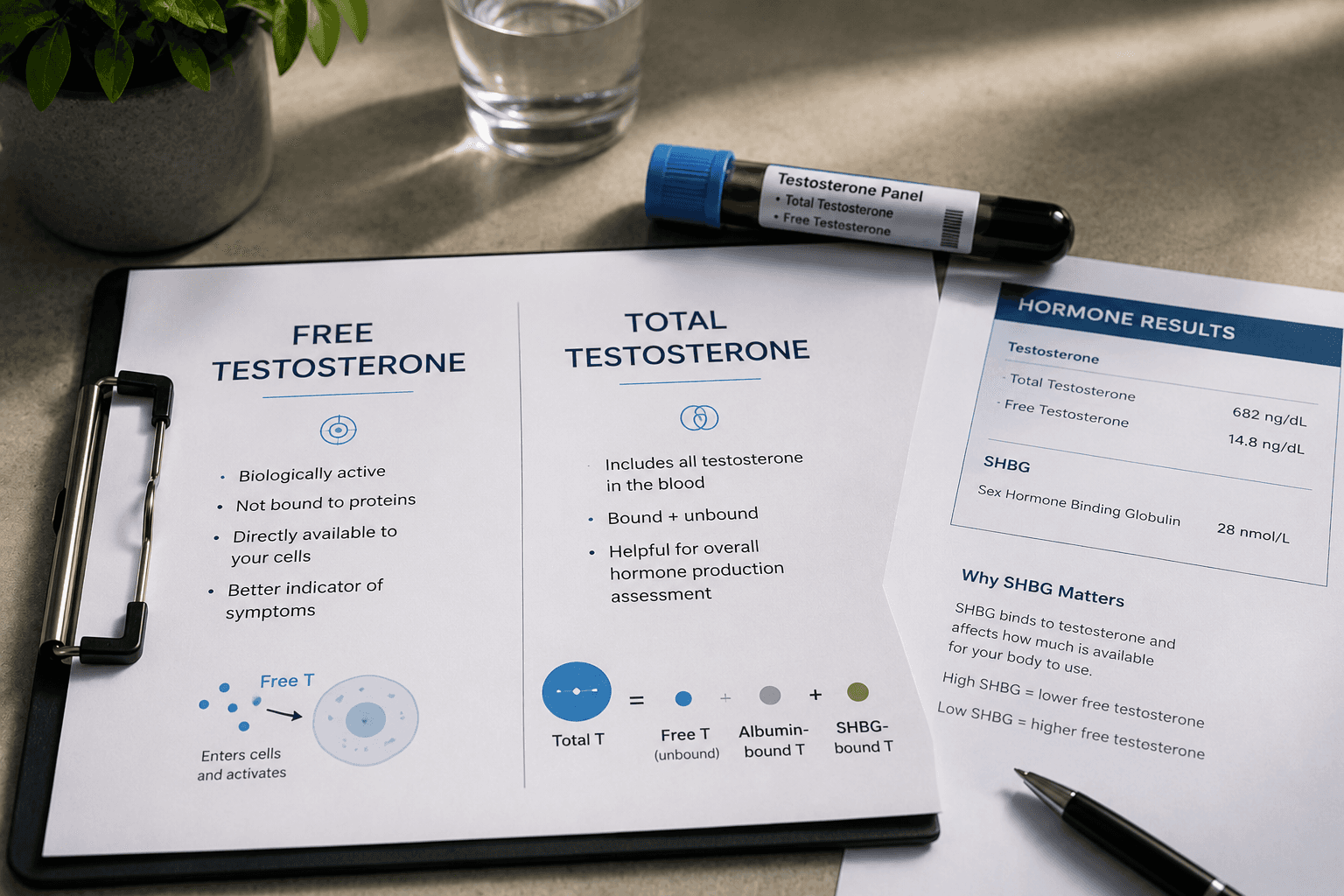
  • Total testosterone measures all the testosterone in your blood — bound and unbound.

  • Free testosterone is the small fraction that's unbound and biologically active.

  • SHBG, a binding protein, determines how much of your total is actually "free."

What total testosterone measures

Total testosterone is the sum of all testosterone circulating in your blood. Most of it (roughly 98%) is bound to proteins — mainly sex hormone-binding globulin (SHBG) and albumin — and isn't immediately available to your tissues. It's the standard first-line test and the basis for most diagnostic thresholds (~264–300 ng/dL depending on the guideline).

What free testosterone measures

Free testosterone is the small unbound fraction — usually about 1–2% of the total — that can actually enter cells and do its job. When symptoms and total testosterone don't line up, free testosterone often explains the gap.

SHBG: the variable everyone forgets

SHBG is the protein that binds testosterone and holds it in reserve. The more SHBG you have, the less testosterone is free — even if your total looks normal. This is why two men with identical total testosterone can feel completely different.

  • High SHBG (from aging, thyroid issues, or liver conditions) lowers free testosterone — a man may have a "normal" total but symptoms of deficiency.

  • Low SHBG (from obesity, insulin resistance, or type 2 diabetes) can make total testosterone look low while free testosterone is relatively preserved.

Which number should you trust?

Total testosterone is the right starting point. Free testosterone becomes especially useful when total is borderline, when SHBG is abnormal, or when symptoms and total don't match. The gold standard for measuring free testosterone is equilibrium dialysis or a calculated value using total testosterone, SHBG, and albumin — direct "analog" free-T assays are considered less reliable.

How to read your results in context

A few principles help:

  • Always test in the morning, when levels peak.

  • Confirm abnormal results with a second test.

  • Interpret numbers alongside symptoms — a number without context means little. For the full symptom picture, see our guide to low testosterone symptoms.

Common misconceptions

  • "Normal total means I'm fine." Not if SHBG is high and free testosterone is low.

  • "Free testosterone is all that matters." Both numbers, plus SHBG, tell the story.

  • "All free-T tests are equal." Calculated or dialysis methods are more reliable than direct analog assays.

When to seek medical care

If your results are borderline or your symptoms don't match your numbers, ask a clinician about checking free testosterone and SHBG. If deficiency is confirmed, explore options in our TRT guide.

Frequently asked questions

Is free or total testosterone more important?
Total is the standard screen; free testosterone clarifies cases where total is borderline or SHBG is abnormal.

What is a normal free testosterone level?
Reference ranges vary by lab and method, so interpret against your lab's range and your symptoms.

What raises SHBG?
Aging, hyperthyroidism, liver disease, and some medications. Obesity and insulin resistance tend to lower it.

When should I get my testosterone tested?
In the morning, ideally twice, and alongside an evaluation of symptoms.

Key takeaways

  • Total = all testosterone; free = the active fraction; SHBG decides the ratio.

  • Check free testosterone when total is borderline or symptoms don't match.

  • Test in the morning, confirm twice, and always read numbers with symptoms.

Get your levels tested and interpreted properly

Sidewalk can connect you with providers who order the right panel and explain what your numbers mean. Learn whether lab testing makes sense for your situation or complete a free AI health assessment.

This article is for educational purposes only and is not a substitute for professional medical advice.

Looking for more? Dive into our other articles, updates, and strategies

New York, NY, USA

@ 2025 Manifold Health All rights reserved

Manifold Health is a health intelligence software provider, not a healthcare provider, insurer, health plan, or medical device manufacturer. The services provided by Manifold Health are intended solely for business and enterprise use and do not include the provision of medical care, diagnosis, treatment, insurance coverage, or payment processing. Manifold Health’s platform is designed to enhance visibility, automation, and decision-making across population health, risk modeling, and cost management workflows. Insights generated by the platform are intended for informational and operational planning purposes only and should not be interpreted as medical advice, clinical guidance, underwriting determinations, or a substitute for professional medical, actuarial, legal, or financial consultation. Access to the Manifold Health platform is subject to our Terms of Use and Privacy Policy. Data entered into the platform is processed in accordance with applicable data protection and privacy laws and stored using enterprise-grade security controls. Manifold Health makes no representations or guarantees regarding clinical outcomes, cost savings, compliance determinations, underwriting decisions, or financial performance resulting from use of the platform. All third-party data sources, integrations, and APIs are provided “as is,” and Manifold Health assumes no responsibility for the accuracy, availability, or continued support of connected services. Manifold Health does not perform claims adjudication, insurance underwriting, regulatory reporting, or clinical decision-making unless explicitly agreed upon through a written service agreement. Use of the Manifold Health platform may involve the transmission of health, claims, eligibility, or laboratory data through secure APIs or manually uploaded files. Customers are solely responsible for ensuring the accuracy of their data, maintaining compliance with applicable laws and regulations (including HIPAA where applicable), and determining how platform insights are used within their organization. Any predictive models, forecasts, or AI-driven insights provided by Manifold Health are forward-looking in nature and should not be relied upon as the sole basis for healthcare, coverage, or financial decisions. Manifold Health is not intended for personal or consumer use. Availability of features—including analytics, forecasting, and automation—may vary by plan level, data source, and geographic region. Manifold Health, Inc. is a privately held company registered in the United States of America. For questions regarding platform usage, licensing, data security, or compliance, please refer to our Help Center or contact support@manifoldhealth.ai.

New York, NY, USA

@ 2025 Manifold Health All rights reserved

Manifold Health is a health intelligence software provider, not a healthcare provider, insurer, health plan, or medical device manufacturer. The services provided by Manifold Health are intended solely for business and enterprise use and do not include the provision of medical care, diagnosis, treatment, insurance coverage, or payment processing. Manifold Health’s platform is designed to enhance visibility, automation, and decision-making across population health, risk modeling, and cost management workflows. Insights generated by the platform are intended for informational and operational planning purposes only and should not be interpreted as medical advice, clinical guidance, underwriting determinations, or a substitute for professional medical, actuarial, legal, or financial consultation. Access to the Manifold Health platform is subject to our Terms of Use and Privacy Policy. Data entered into the platform is processed in accordance with applicable data protection and privacy laws and stored using enterprise-grade security controls. Manifold Health makes no representations or guarantees regarding clinical outcomes, cost savings, compliance determinations, underwriting decisions, or financial performance resulting from use of the platform. All third-party data sources, integrations, and APIs are provided “as is,” and Manifold Health assumes no responsibility for the accuracy, availability, or continued support of connected services. Manifold Health does not perform claims adjudication, insurance underwriting, regulatory reporting, or clinical decision-making unless explicitly agreed upon through a written service agreement. Use of the Manifold Health platform may involve the transmission of health, claims, eligibility, or laboratory data through secure APIs or manually uploaded files. Customers are solely responsible for ensuring the accuracy of their data, maintaining compliance with applicable laws and regulations (including HIPAA where applicable), and determining how platform insights are used within their organization. Any predictive models, forecasts, or AI-driven insights provided by Manifold Health are forward-looking in nature and should not be relied upon as the sole basis for healthcare, coverage, or financial decisions. Manifold Health is not intended for personal or consumer use. Availability of features—including analytics, forecasting, and automation—may vary by plan level, data source, and geographic region. Manifold Health, Inc. is a privately held company registered in the United States of America. For questions regarding platform usage, licensing, data security, or compliance, please refer to our Help Center or contact support@manifoldhealth.ai.

New York, NY, USA

@ 2025 Manifold Health All rights reserved

Manifold Health is a health intelligence software provider, not a healthcare provider, insurer, health plan, or medical device manufacturer. The services provided by Manifold Health are intended solely for business and enterprise use and do not include the provision of medical care, diagnosis, treatment, insurance coverage, or payment processing. Manifold Health’s platform is designed to enhance visibility, automation, and decision-making across population health, risk modeling, and cost management workflows. Insights generated by the platform are intended for informational and operational planning purposes only and should not be interpreted as medical advice, clinical guidance, underwriting determinations, or a substitute for professional medical, actuarial, legal, or financial consultation. Access to the Manifold Health platform is subject to our Terms of Use and Privacy Policy. Data entered into the platform is processed in accordance with applicable data protection and privacy laws and stored using enterprise-grade security controls. Manifold Health makes no representations or guarantees regarding clinical outcomes, cost savings, compliance determinations, underwriting decisions, or financial performance resulting from use of the platform. All third-party data sources, integrations, and APIs are provided “as is,” and Manifold Health assumes no responsibility for the accuracy, availability, or continued support of connected services. Manifold Health does not perform claims adjudication, insurance underwriting, regulatory reporting, or clinical decision-making unless explicitly agreed upon through a written service agreement. Use of the Manifold Health platform may involve the transmission of health, claims, eligibility, or laboratory data through secure APIs or manually uploaded files. Customers are solely responsible for ensuring the accuracy of their data, maintaining compliance with applicable laws and regulations (including HIPAA where applicable), and determining how platform insights are used within their organization. Any predictive models, forecasts, or AI-driven insights provided by Manifold Health are forward-looking in nature and should not be relied upon as the sole basis for healthcare, coverage, or financial decisions. Manifold Health is not intended for personal or consumer use. Availability of features—including analytics, forecasting, and automation—may vary by plan level, data source, and geographic region. Manifold Health, Inc. is a privately held company registered in the United States of America. For questions regarding platform usage, licensing, data security, or compliance, please refer to our Help Center or contact support@manifoldhealth.ai.